How to start forex trading in 2026 with a simple market structure strategy
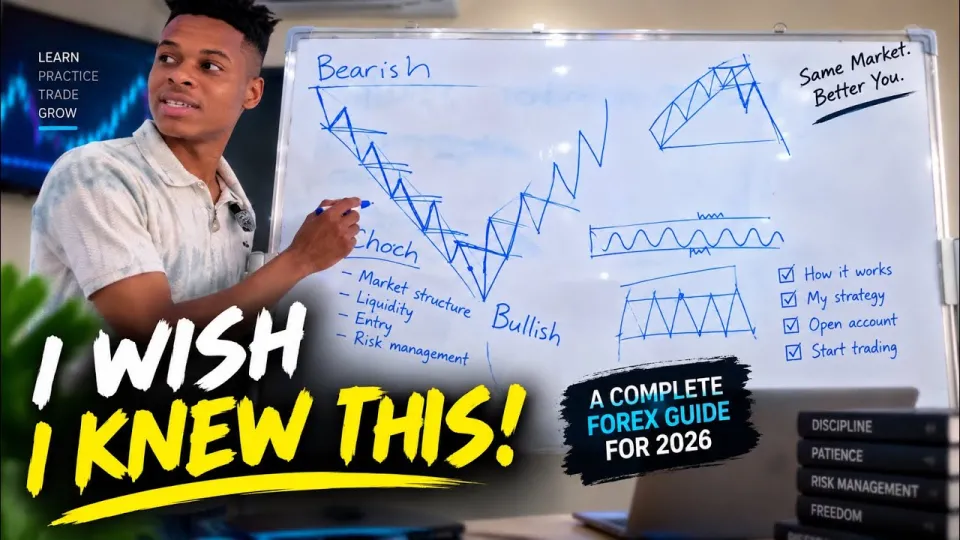
Video: How To Start Forex Trading For Beginners in 2026 (Full Guide + My Strategy)
Need articles like this for your video? They help promote it on YouTube and Google — order them in the Telegram bot @sat_sit_bot. It writes articles around your video, embeds the video and publishes them on popular niche websites (no ads). Your first 50 articles are free.
· based on the channel Carl Fx
Key takeaways
- Forex is an over-the-counter market of currency pairs, open roughly 24 hours a day, five days a week, from the Monday open in Asia to the Friday close in New York.
- A beginner needs three things before risking money: a regulated broker with a demo account, a written trading plan and a fixed risk limit per trade, commonly 1% of the account.
- Market structure (higher highs and higher lows versus lower highs and lower lows) is the base layer of most price action strategies, including the one Carl Fx outlines.
- Most beginner losses come from oversized positions, revenge trading after a loss and skipping the demo phase, not from a lack of indicators.
- The video links to a TFC Global Markets sign-up page, which the creator openly discloses as his own brokerage.
Starting forex trading means opening a demo account with a regulated broker, learning how currency pairs move, and practising a single strategy on a small, fixed risk until the process becomes routine. You do not need a large balance or a wall of indicators to begin; you need a repeatable method, a risk limit and enough screen time to read price. The guide below follows the structure of Carl Fx's beginner walkthrough and adds the practical detail you need to act on it, starting with registration at TFC Global Markets.
What forex trading actually is and how the market is organised
Forex is the exchange of one currency for another, and the price you see on a chart is simply the ratio between two currencies at a given moment. Trading happens over the counter rather than on a single exchange, which means brokers quote prices and route orders through a network of banks and liquidity providers. The market runs around the clock from Monday morning in Asia to Friday evening in New York, with the heaviest activity during the London and New York sessions.
A few mechanics matter from day one:
- Pairs come in two types. Majors such as EUR/USD, GBP/USD and USD/JPY carry the tightest spreads; exotics such as USD/ZAR or USD/TRY are thinner and more volatile.
- Prices are quoted in pips, the fourth decimal for most pairs and the second for yen pairs. One pip is the standard unit for measuring both moves and risk.
- Leverage lets you control a position larger than your deposit. It magnifies both gains and losses, which is why position size, not leverage itself, decides whether an account survives.
- Spread, commission and swap (the overnight financing charge) are your running costs. A strategy that ignores them can look profitable on paper and lose money in practice.
Opening your account and setting up a chart
A trading account is opened in two stages: registration and verification, followed by a deposit only once you have tested the platform. Carl Fx points viewers to the TFC Global Markets sign-up page and discloses in the video description that he owns the brokerage, so treat the link as a commercial recommendation and compare regulation, spreads and withdrawal terms before funding anything.
A sensible setup sequence looks like this:
- Register and complete identity verification, which most regulated brokers require before withdrawals.
- Open a demo account first and keep it running for at least a month of consistent screen time.
- Install the broker's platform, usually MetaTrader 4, MetaTrader 5 or a proprietary web terminal, and build one clean chart layout.
- Add only what you will actually use: a candlestick chart, a session indicator if you trade specific hours, and horizontal lines for highs and lows. Skip oscillators until your structure reading is solid.
- Mark the previous day's high and low, the previous week's high and low, and the obvious swing points on your pair. These levels are the raw material for the strategy below.
Reading bullish and bearish markets through market structure
Market structure is the sequence of swing highs and swing lows, and it tells you which side of the market is currently in control. A bullish market prints higher highs and higher lows; a bearish market prints lower highs and lower lows. When that sequence breaks, the market is either ranging or reversing, and the correct response is to wait rather than to force a trade.
The practical routine is short:
- Mark the most recent clear swing high and swing low on your timeframe.
- Label the trend from the sequence, not from how you feel about the news.
- Wait for price to return to a level where the previous move started, such as an order block or a broken structure level.
- Look for confirmation, a rejection candle or a change of structure on a lower timeframe, before entering.
This is the core of the price action approach Carl Fx teaches: context first, entry second. Beginners often invert the order, hunting for an entry signal and then inventing a reason for it. Structure gives you a filter that removes most low-quality setups before they cost you money.
A simple strategy you can practise this week
The strategy is a structure-based pullback: trade with the trend only, enter on a return to the level that created the last impulse, and place the stop beyond the swing that would invalidate the idea. It is deliberately plain, because a simple plan executed consistently beats a complicated one executed emotionally.
- Pick one pair, ideally a major such as EUR/USD, and one timeframe for direction, for example the four-hour chart.
- Confirm the trend from the swing sequence: higher highs and higher lows for longs, lower highs and lower lows for shorts.
- Drop to a lower timeframe, such as 15 minutes, and wait for price to pull back into the origin of the last strong move.
- Enter after a confirmation signal, with the stop loss placed beyond the swing low for a long or the swing high for a short.
- Set risk at a fixed percentage of the account, commonly 1%, and calculate lot size from the distance between entry and stop rather than guessing.
- Target at least twice your risk so that a modest win rate still produces a positive result, and log every trade with a screenshot.
Run this on demo for 30 to 50 trades before going live. If the log shows no edge, change one variable at a time rather than rebuilding the whole system.
Common beginner mistakes and the questions new traders keep asking
The most expensive mistakes in forex are behavioural, not analytical. Oversizing a position turns a normal losing streak into an account-ending event, and moving a stop loss to avoid taking a loss converts a small controlled loss into a large uncontrolled one. Revenge trading after a loss, jumping between strategies every week and trading during high-impact news without a plan round out the list.
Questions that come up constantly from newer viewers of beginner forex content tend to cluster around a few themes:
- Whether a demo account is worth the time. It is, because it lets you build the habit of following rules without paying tuition to the market.
- Whether a small account can grow. It can, but only through consistent risk control; small balances and aggressive leverage are a poor combination.
- Whether a broker account can be opened from a specific country. Availability and payment methods vary by jurisdiction, so check the broker's accepted regions and local regulation before registering.
- Whether chart examples are needed. They are, and the fastest way to get them is to mark up your own charts daily rather than only watching someone else's.
How to build discipline and manage risk from the first trade
Risk management is the part of forex trading that keeps you in the game long enough to learn. Decide before the session how much you are willing to lose that day, cap risk per trade at a fixed percentage, and stop trading when the cap is hit. A common beginner framework is 1% risk per trade with a maximum of three trades per day, which limits a bad day to roughly 3% of the account.
Alongside the numbers, build a routine: review the economic calendar each morning, note the sessions you can actually trade, journal every entry with the reason and the outcome, and review the journal weekly. Discipline is not a personality trait; it is a set of habits repeated until they are automatic. Carl Fx makes the same point in the video: trading is not about getting rich overnight, it is about learning, managing risk and improving daily.
Useful links
- Broker registration used in the video: https://www.tfcglobalmarkets.com/sign-up?ref=CARLFX
- Free Telegram community: https://t.me/carlsmcforex
Final thoughts on starting forex the right way
Forex rewards patience and punishes improvisation, so the order of operations matters more than the strategy you pick: learn how the market is structured, open a demo, practise one setup, and only then risk real money at a fixed percentage per trade. The framework in this guide comes from the beginner walkthrough published by Carl Fx, whose channel covers trading, discipline and personal growth, and the video is a reasonable starting point for anyone building a first plan. Treat the broker link as a commercial offer, verify regulation yourself, and measure progress in months of consistent execution rather than in a single winning week. If you are ready to begin, start with registration at TFC Global Markets and keep the first account on demo until your journal proves the process works.
Source: How To Start Forex Trading For Beginners in 2026 (Full Guide + My Strategy) · Markdown version
Questions & answers
How much money do I need to start forex trading?
You can open many accounts with a few hundred dollars, but the amount matters less than the risk per trade. With 1% risk, a 500 dollar account risks 5 dollars per trade, which limits position size and forces discipline. Many beginners stay on demo until they can fund an account they are not afraid to lose.
Is a demo account really necessary before trading live?
Yes, because it separates learning the platform and the strategy from losing real money on mistakes. A useful benchmark is 30 to 50 logged demo trades with a stable process before switching to a small live account. Demo results are not proof of future profit, but they expose whether you follow your own rules.
Can I open a broker account from any country?
No, availability depends on the broker's accepted jurisdictions and local regulation, and payment methods differ by region. Check the broker's registration requirements and whether it is regulated in a jurisdiction that covers you before depositing. If verification fails, contact support rather than using a third-party account.
How long does it take to become consistently profitable in forex?
Most traders need many months of structured practice, journaling and review before results stabilise, and some never get there. Progress comes from a fixed strategy, capped risk and honest record keeping rather than from a single course or indicator. Treat early profits as unproven until they survive a larger sample of trades.